

 Wealth Insights
|
December 9, 2025
Double, Double, Toil and Trouble: How to Navigate Market Volatility
Written by Communications at MASECOThe financial media and market commentators persist with scaremongering and speculation. An AI ‘bubble’, the future of cryptocurrency and Bitcoin, government debt levels, ongoing trade wars, and other geopolitical tensions dominate headlines. In general, this is nothing new. It is a feature of capital markets and the noise that surrounds them—making a clear market volatility investment strategy essential for long-term success.
At the end of the day, a buyer and a seller come together to agree the price based on the information they have available and how they process this information – with enough participants this information gets baked into market prices. Said differently, if all participants thought there was a market bubble, it would already have ‘popped’.
Technically, a true believer in ‘efficient’ markets will deny that bubbles exist – any price changes result in changes in the perceived underlying risks and expected cashflows. An efficient market is one where today’s prices reflect all known information, such that any participant cannot know something that the market already does not. Market prices are always, therefore, fair and justified.
On the opposite side of the coin, a behaviourist will prefer the argument that sentiment towards markets ebbs and flows through time, and drives prices accordingly.
In reality, both are just models.
Evidence supports an approach to act as if markets are effective enough at pricing information, such that building an investment proposition on the opposite belief does not give an investor the best chance of a successful investing experience.
One might have sympathy for arguments that excitement and ‘FOMO’ can creep into investor choices, perhaps distorting prices. There exists the risk that many investors do not fully understand the risks inherent in stock markets and could be stung if momentum changes course sharply – which it can, and has done in the past.
An investor then faces the temptation to do something on the back of a belief that prices are unjustifiably elevated. It is, however, clear from the evidence that few, if any, possess the ability to act on and profit from this changing behaviour reliably.
Recent research examined 720 market timing strategies across equity market, size, value, and profitability premiums in various regions. Only 30 showed initial promise, and even those were highly sensitive to time periods and construction methods. Without rigorous testing, it’s easy to mistake noise for a signal. Sadly, the ‘elixir’ remains elusive.
Figure 1: Success of simulated market timing strategies
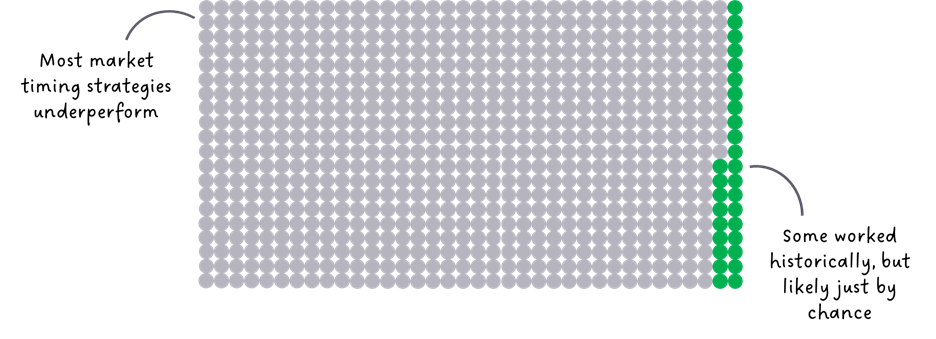
Data source: Another Look at Timing the Equity Premiums. Dai W, Dong A. Dimensional Fund Advisers – Research (2023). Graphic: Albion Strategic Consulting.
The future is uncertain, with many plausible scenarios and a wide range of views. Fortunately, investors who trust in broadly efficient markets can rely on the collective intelligence of participants. This vast web of risks and probabilities is distilled into a single figure: the price.
It is worth remembering that every decision to exit an asset class requires a subsequent decision on when to re-enter.
As John C. Bogle, founder of Vanguard, famously said:
The idea that a bell rings to signal when investors should get into or out of the stock market is simply not credible… I don’t even know anybody who knows anybody who has done it successfully and consistently.
The cost of getting it wrong – whether through emotional decisions or misplaced confidence in a ‘system’ – can be high. The world may well be in ‘bubble’ territory. Equally, it may not. Only with hindsight will any investor know with any degree of confidence.
Stay the course.
The Legal stuff
The information contained herein is subject to copyright with all rights reserved. The document may not be copied, forwarded or otherwise distributed, in whole or in part, to any other party without our written consent.
Important notes
This is a purely educational document to discuss some general investment related issues. It does not in any way constitute investment advice or arranging investments. It is for information purposes only; any information contained within them is the opinion of the authors, which can change without notice. Past financial performance is no guarantee of future results.
Products referred to in this document
Where specific products are referred to in this document, it is solely to provide educational insight into the topic being discussed. Any analysis undertaken does not represent due diligence on or recommendation of any product under any circumstances and should not be construed as such.
Risk Warnings
All investments involve risk and may lose value. The value of your investment can go down depending upon market conditions and you may not get back the original amount invested.
Your capital is always at risk.
Fluctuation in currency exchange rates may cause the value of an investment and/or a portfolio to go up or down.
Alternative strategies involve higher risks than traditional investments, such as speculative investment techniques, which can magnify the potential for investment loss or gain.
Certain products which may be used within a portfolio in order to give exposure to particular investment strategies may not be regulated in the UK and therefore will not have the benefit of the protections afforded by the UK regulatory regime.
MASECO Asia Limited (CE number: BHR224), trading as MASECO Asia, is limited company in Hong Kong and has its registered office at Suite 2111, 21/F New World Tower, 16-18 Queen’s Road Central, Central, Hong Kong. Telephone calls may be recorded for your protection.
MASECO Asia Limited (CE# BHR224) is authorized and regulated by the Securities and Futures Commission of Hong Kong to carry out Type 9 Regulated Activities. MASECO Asia Limited (CRD #310966) is also registered with the US Securities and Exchange Commission as a Registered Investment Advisor.
The firm participates in industry award programmes relating to the provision of its investment services and in connection therewith the firm may be required to pay an administration fee for the submission of its application. Where such payments are made, they will be nominal in value and will not be in exchange for any form of guarantee or promise that the firm will receive the award for which it has applied. The firm only participates in award programmes where there is an independent panel of judges.